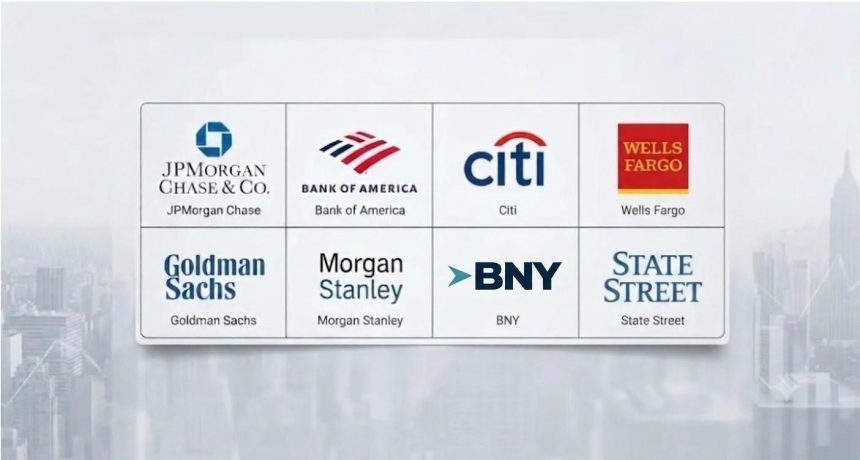
All of America’s eight globally systemically important banks reported significantly higher revenues and net income than the same period in 2025, and in comparison to the first quarter in 2026. Nothing in banks’ earnings should tell anyone they need to be deregulated, quite the contrary, especially since elevated levels of inflation are putting pressure on consumer and real estate borrowers.
Net Interest Margin (NIM)
Across the group, NIM performance was highly split based on bank structure:
- The Trend: For the commercial giants (JPMorgan, BofA, Citigroup, and Wells Fargo), NIMs faced continuous flat-to-downward pressure compared to Q2 2025.
- The Driver: Even with high benchmark interest rates, deposit betas remained incredibly sticky. Customers continued migrating funds out of zero-interest checking accounts and into higher-yielding CDs.
- The Exceptions: Trust banks (BNY and State Street) managed to stabilize their net interest income relatively well due to their specialized, highly structured institutional deposit bases, while investment-heavy banks (Goldman and Morgan Stanley) are naturally less sensitive to NIM fluctuations.
Trading and Investments
This was the absolute engine of growth for Q2 2026, showing stellar improvement compared to a sluggish Q2 2025.
- Fixed Income, Currencies, and Commodities (FICC): Trading desks saw solid, steady volume, though it was slightly softer than the highly volatile quarters of late 2025.
- Equities Trading: A standout performer. Morgan Stanley and Goldman Sachs recorded near-record quarters in equity trading, driven by high institutional trading volumes and active client positioning in tech and macro-driven assets.
- Principal Investments: Equity investments held on bank balance sheets saw marked valuation gains due to strong public equity markets through the first half of 2026.
Fees (Non-Interest Income Breakdown)
Fees were the undisputed savior of the quarter, exhibiting sharp increases compared to both Q1 2026 and Q2 2025. When we look at “fees” for these eight banks, they fall into three distinct buckets:
- Investment Banking Fees (Advisory & Underwriting): This was the main story. Goldman Sachs (+55% YoY) and Morgan Stanley experienced a massive surge in debt and equity underwriting fees as corporations rushed to issue bonds and IPO windows opened wider. M&A advisory fees also saw a strong cyclical rebound.
- Asset Management and Administration Fees: BNY, State Street, and Morgan Stanley (whose Wealth Management division surpassed $10 trillion in client assets) saw record inflows. Because these fees are calculated as a percentage of Assets Under Custody/Management (AUC/AUM), high market valuations directly translated into higher recurring fee revenue.
- Card and Transaction Fees: For JPMorgan, BofA, and Citi, consumer swipe fees and credit card annual fees remained robust, indicating that nominal consumer spending has not collapsed.
Provisions for Credit Losses (Loan Loss Reserves)
To protect themselves against potential defaults, banks set aside “provisions for credit losses.” Provisions generally rose compared to both Q1 2026 and Q2 2025, but the build-up was highly targeted.
- Compared to Q2 2025: Provisions are notably higher across the consumer-heavy lenders. JPMorgan, Bank of America, and Citigroup have steadily increased their credit card reserves as net charge-offs (debts deemed uncollectible) have normalized back to—and in some cases, slightly exceeded—pre-pandemic levels.
- Compared to Q1 2026: Reserves increased moderately or held steady at high levels. Wells Fargo and Citigroup, in particular, added to their reserve piles to cover ongoing uncertainties in their commercial real estate portfolios and international credit exposures.
- The Outliers: Goldman Sachs and Morgan Stanley, having largely spun down or scaled back their direct consumer lending experiments over the last two years, did not have to build credit provisions at the same aggressive rate as their commercial peers. BNY and State Street, as trust banks with minimal traditional loan books, remained largely unaffected by credit provision builds.
Signals of Trouble Spots Ahead
While the headline earnings beat expectations, executives pointed to several emerging “cracks in the armor” during their Q2 earnings calls:
- Lower-Income Consumer Stress: Credit card delinquency rates are continuing to tick upward. While high-income consumers are still spending actively, the lower-to-middle-income demographics are showing clear signs of exhaustion, leading to higher credit card write-offs.
- Commercial Real Estate (CRE) Office Refinancing: A massive wall of commercial office debt is scheduled to mature over the next 18 months. Wells Fargo and Citigroup executives noted they are closely watching these maturities, as properties refinancing at current high interest rates face steep valuation drops, potentially triggering default events.
- Sluggish Corporate Loan Demand: Despite strong investment banking activity, actual commercial and industrial (C&I) loan growth was tepid. Corporations are avoiding taking on expensive long-term debt, which limits the banks’ ability to grow their core loan books.
- Regulatory Capital Drag: Looming regulatory changes (Basel III Endgame adjustments) continue to hang over these banks. While the rules are expected to be dialed back from their original proposals, the uncertainty is forcing these institutions to hoard capital rather than returning it to shareholders via aggressive buybacks.
Read the full article here